
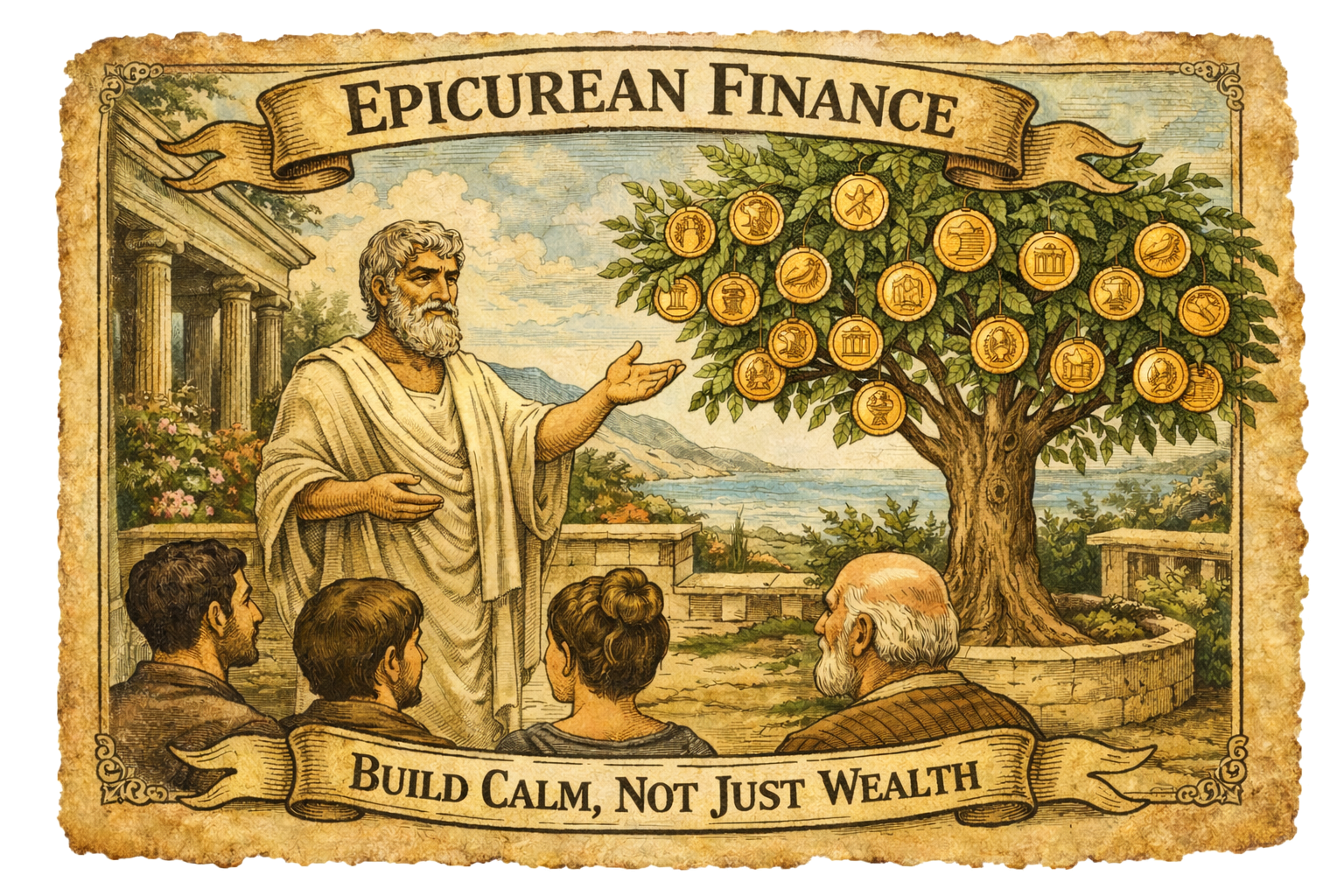
 Epicurean finance is my term for a way of thinking about money. It isn't a historical school or a body of financial advice that Epicurus himself wrote. As far as I know, he did not leave behind a lost scroll on deductible selection or asset allocation. I use the phrase to describe my own attempt to apply Epicurean ideas to financial systems design. That framing is worth learning about because it offers a better target than the one most financial advice gives you. A lot of money writing is built around maximizing returns, minimizing costs, and growing net worth as efficiently as possible. Those things matter, but they aren't the final goal. Money is a tool, not an end in itself, and the point of using that tool well isn't merely to maximize numbers on a spreadsheet, but to build a life with less fear, less instability, less regret, and less needless distress.
That is where Epicurean finance comes in. Epicurean finance is the design of financial systems to reduce lifetime suffering and increase day-to-day peace, while still respecting sound financial reasoning. It treats money as a tool for shaping the lived experience of a life, not as a scorecard to be maximized for its own sake. That framing matters because it changes the questions you ask. Instead of asking only, "What earns the most?" or "What is optimal on average?" it leads you to ask, "What system can I actually live with?" "What reduces fear and regret?" and "What helps me avoid avoidable misery?" Those are not the usual personal-finance brochure questions, but they are often the more important ones.
That shift is useful because real financial life isn't lived in averages or spreadsheets. It's lived through uncertainty, bad timing, stress, temptation, and the occasional run of rotten luck. A good financial system therefore has to do more than make theoretical sense. It has to remain livable when life gets messy. A strategy that looks slightly better on paper may still be worse in practice if it creates chronic anxiety, sharp financial shocks, constant second-guessing, or a high risk of panic-driven mistakes. A plan that wins in a spreadsheet and falls apart in a human being is not as impressive as it sounds.
This isn't an excuse for irrationality, laziness, or indulgence. Epicurean finance doesn't reject math, expected value, or disciplined planning. It simply refuses to pretend that emotional life is irrelevant to financial outcomes. If a financial system reliably produces fear, regret, and disruption, then those are real costs, even if they don't show up neatly in a net-worth chart. Unfortunately, your nervous system does not accept payment in theoretical long-run averages.
In that sense, Epicurean finance isn't about choosing comfort over reason. It's about using reason to build a calmer life. The goal isn't to squeeze every last theoretical dollar from your assets, but to arrange money in a way that makes life more stable, more bearable, and less dominated by avoidable suffering. The rest of this article is about that broader way of thinking: why it matters, how it differs from standard personal finance, and what kinds of systems it tends to favor.
Design for the Life You Actually Have to Live
 The core principle of Epicurean finance is simple: a financial system should be designed for the life you actually have to live, not for an imaginary life in which you are always calm, perfectly rational, unusually lucky, and immune to stress. It is easy to build a plan that works beautifully in a spreadsheet. It is much harder to build one that still works when your car breaks down, your mood is bad, your attention is elsewhere, the market is falling, and life decides this would be a funny week to pile on.
That is why Epicurean finance cares so much about sturdiness. A good financial plan should survive bad luck, reduce the damage of mistakes, and remain usable under ordinary human conditions. It should not depend on perfect discipline, perfect timing, or perfect emotional control. A system that only works when everything goes right is not really a system. It is a wish with bullet points.
This way of thinking changes what counts as a good result. A plan is not good merely because it has the highest expected return or the lowest theoretical cost. It is good if it is emotionally sustainable, simple enough to keep using, and unlikely to trigger panic or self-sabotage when life gets messy. A financial system should not merely look optimal under average conditions. It should remain livable under real conditions.
That standard may sound modest, but it is actually demanding. It requires you to think not just about what is mathematically elegant, but about what is durable in the hands of an imperfect human being. In practice, that often means preferring systems that are a little less impressive in theory and a lot more reliable in real life. A plan that you can calmly stick with is often better than a plan that looks brilliant right up until the moment you blow it up.
The Kinds of Systems Epicurean Finance Tends to Favor
 Once you start thinking in Epicurean terms, certain kinds of financial systems begin to look much better than they do under a pure wealth-maximization framework. The reason is not mysterious. If your goal is to reduce lifetime suffering, then you will naturally be drawn toward systems that lower fear, reduce regret, absorb shocks, and make it easier to keep functioning sensibly when life gets messy. That does not mean chasing comfort at any price. It means recognizing that some financial arrangements are much easier to live with than others, and that this matters. A system does not have to be exciting to be good. In finance, exciting often means something has already gone wrong.
One broad example is insurance. In strict expected-value terms, insurance is often not a great deal. The insurer needs to make a profit, and dealing with insurance companies can be its own special form of suffering. Even so, insurance can make sense because it smooths financial experience. It turns rare but brutal losses into smaller recurring costs, and for many people that trade reduces the amount of distress their finances can inflict on them. In Epicurean terms, that kind of smoothing can be worth paying for. Sometimes the product you are buying is not a financial bargain so much as a reduction in the odds that your week turns into a three-act tragedy.
Another example is broad index investing. A simple index fund does not offer the thrill of outsmarting the market, but it does offer something more useful: a strategy that is psychologically sturdy. When people try to beat the market and fail, the pain is not just financial. It is tangled up with regret, self-blame, and the temptation to do something stupid at exactly the wrong time. Broad indexing reduces that risk. It gives up some excitement in exchange for a plan that is easier to stick with when markets are ugly, which is not glamorous but is often a very good bargain. There is a lot to be said for a strategy that does not require you to feel like a genius in order to keep using it.
Epicurean finance also tends to favor cash buffers, automation, and systems with low ongoing friction. Cash reserves can look inefficient when nothing is going wrong, but they are very efficient at preventing panic. Automation can look boring, but boring systems are often excellent systems because they reduce temptation, forgetfulness, and decision fatigue. Likewise, a simple account structure or a credit-card system with clear roles may not look clever enough to impress anybody at a dinner party, but it can make day-to-day life much easier to manage, and that has real value. A system that quietly does its job without demanding constant heroics deserves more respect than it usually gets.
More generally, Epicurean finance tends to prefer systems that are simple, sturdy, and forgiving. It likes plans that do not require perfect timing, perfect discipline, or constant vigilance. It likes arrangements that assume bad luck will eventually show up, because bad luck usually does. It likes strategies that leave room for human weakness, imperfect attention, and the occasional rough stretch, because those are not unusual exceptions. They are part of the basic operating environment. Human beings are not robots, and even if they were, many of them would probably still need a reboot on a Tuesday.
That does not mean Epicurean finance always chooses the safest or most conservative option in every case. It means it takes psychological durability seriously. A system earns points if it helps a person remain calm, avoid self-sabotage, and continue making decent decisions under stress. If two plans are roughly comparable in their financial merits, but one of them is far easier to live with, far less likely to trigger panic, and far more likely to survive a bad month or bad year, Epicurean finance will usually see that as a meaningful advantage rather than a side note.
Why Epicurean Finance Favors Those Kinds of Systems
 The kinds of systems Epicurean finance tends to favor are not arbitrary. They follow from the basic idea that the emotional effects of financial systems are not side issues. They are part of the outcome. A strategy does not become wise merely because it produces a slightly better expected result on paper. If it also produces more fear, more regret, more fragility, or a higher chance of panic-driven mistakes, then those costs belong in the evaluation too. The mind is not some decorative accessory attached to a spreadsheet. It is the place where financial life is actually lived.
This matters because people do not experience gains and losses symmetrically. A gain can feel good, but a loss of the same size often feels much worse. That means a strategy that exposes a person to occasional sharp losses may impose more suffering than a simple average would suggest. By the same token, a strategy that smooths out those shocks may improve life more than a narrow expected-value calculation would capture. The emotional shape of an outcome matters, not just its mathematical size.
It also matters because people do not plan neutrally. They tend to imagine that things will go reasonably well, that bad outcomes are a little farther away than they really are, and that future problems will somehow arrive one at a time in an orderly and well-mannered fashion. Real life is often rude enough not to cooperate. Financial systems therefore need to be judged not just by how they perform in an average scenario, but by how they behave when luck turns sour, timing is bad, and several annoying things decide to become close personal friends all at once.
Another reason these tendencies make sense is that human beings are not perfectly disciplined creatures with infinite attention. People get tired, distracted, discouraged, and tempted. They procrastinate, second-guess themselves, forget things, and sometimes make a complete hash of decisions they would have handled just fine on a better day. A good financial system takes that seriously. It does not assume ideal behavior as a starting condition. It tries to reduce the number of moments in which flawless behavior is required.
That is why Epicurean finance so often favors simplicity, automation, buffers, and psychologically sturdy plans. These are not random preferences or aesthetic quirks. They follow from a view of human life in which emotional strain, cognitive bias, limited attention, and bad luck are normal features of the landscape. Once those things are treated as real constraints rather than embarrassing footnotes, these preferences begin to look less like soft compromises and more like ordinary common sense.
Biases as Planning Constraints
 One of the main ideas behind Epicurean finance is that human biases should not be treated merely as errors to be corrected. They should also be treated as planning constraints. A financial system has to work with the kind of minds human beings actually have, not with the kind of minds economists, self-help writers, or spreadsheet enthusiasts sometimes wish they had. This does not mean every bias is wise or should be indulged without question. It means a bias is part of the operating environment, and pretending otherwise is usually an expensive form of optimism. Reality has a way of charging extra for plans that depend on imaginary people.
Take loss aversion. People tend to feel losses more intensely than they feel equivalent gains. A standard financial framework may treat this as a distortion to be corrected, but an Epicurean framework asks a different question: given that losses hurt this much, how should a sane person plan around that fact? If sharp losses cause outsized suffering, then financial systems that reduce their frequency, size, or emotional force may be more valuable than a narrow expected-value analysis would suggest. A spreadsheet may call two outcomes equivalent, but the human nervous system is often not impressed by that argument.
The same goes for the planning fallacy and optimism bias. People tend to plan as though things will work out rather smoothly, as though delays will be minor, and as though bad outcomes will somehow stay politely hypothetical. Since real life does not reliably share that optimism, a good system should not lean too hard on rosy assumptions. It should assume that bad luck will eventually show up, that costs may arrive at inconvenient times, and that life will occasionally behave as though it has a personal grudge. It is usually safer to assume that the universe will not be coordinating its schedule around your preferences.
Regret aversion matters too. Some strategies are not hard because they are mathematically bad. They are hard because they are emotionally brutal to stick with. A person trying to beat the market may not just suffer investment losses in a bad year. He may suffer the special misery of feeling personally foolish, which often creates a powerful temptation to abandon the plan at exactly the wrong moment. When a strategy predictably generates second-guessing and self-blame, that is not just a character issue. It is a design issue. A plan that requires you to feel noble, calm, and above regret at all times is asking for a little too much on a Wednesday.
Other biases point in the same direction. Present bias makes it easier to neglect long-term goals for short-term relief or pleasure. Decision fatigue makes complicated systems decay over time, even when they looked impressive at the start. Availability bias can make people underprepare during calm periods because recent memory is full of non-disasters rather than disasters. None of this means people are hopeless. It means systems should be built with these tendencies in mind instead of treating them as embarrassing little defects that will surely vanish once the reader has absorbed enough wisdom from a blog post. Human beings rarely become flawless just because somebody explained a concept nicely.
This is why Epicurean finance treats biases as constraints to design around rather than merely flaws to lecture about. A good engineer does not complain that gravity exists. He builds with it in mind. In the same way, a good financial planner should not assume away loss aversion, optimism bias, procrastination, limited attention, or regret sensitivity. Those things are part of the human condition. A financial system that respects them has a better chance of surviving contact with real life, which is where all financial systems are eventually tested whether they feel ready or not. Real life does not care how elegant the theory looked in the draft stage.
Contrast with Standard Personal Finance
 Epicurean finance differs from standard personal finance mainly in what it treats as the real goal. Standard personal finance usually aims at maximizing net worth, optimizing returns, minimizing taxes, reducing fees, and improving efficiency. Those are sensible goals as far as they go. If you ignore them completely, you will usually make a mess of things. The problem is not that standard personal finance is wrong about these concerns. The problem is that it often treats them as if they were the whole story.
That creates a subtle distortion. Once wealth maximization becomes the default goal, everything else starts looking secondary. Fear, regret, fragility, decision fatigue, and the ability to stay calm during bad stretches get treated as side issues, or at best as unfortunate little footnotes attached to an otherwise optimal plan. But those things are not footnotes in lived experience. They are part of what a financial life actually feels like. A plan that looks excellent in theory may still be a bad plan for a particular person if it makes ordinary life more stressful, more brittle, or more likely to end in panic and self-sabotage.
Epicurean finance starts from a broader question. Instead of asking only, "How do I get the highest return?" or "How do I build the largest pile?" it asks, "What kind of financial system makes life more stable, less frightening, and easier to live well?" That does not mean ignoring returns, costs, or long-term growth. It means putting them back into their proper place as means rather than ends. Money matters because it affects the texture of a life. If it stops serving that purpose and turns into a scorekeeping obsession, the system has quietly started serving itself.
This difference shows up in practical judgments. Standard personal finance may prefer the option with the slightly better expected value, even if it demands more vigilance, more emotional toughness, and more tolerance for ugly surprises. Epicurean finance is often more willing to accept a little inefficiency in exchange for sturdiness, simplicity, and peace of mind. That is not because it despises math. It is because it notices that human beings do not live inside expected values. They live inside sequences of days, moods, setbacks, temptations, and occasional bouts of nonsense.
So the contrast is not between rational finance and soft finance, or between serious people and sentimental people. The real contrast is between a framework that treats human experience as secondary and one that treats it as part of the result. Standard personal finance is usually very good at asking how to make money behave efficiently. Epicurean finance adds a different question: how do we arrange money so that life hurts less? That is a less flashy goal, perhaps, but it has the advantage of being related to an actual human life.
Contrast with Behavioral Economics
 Epicurean finance also differs from behavioral economics, though the two overlap in obvious ways. Behavioral economics is full of useful observations about how people actually think and behave. It notices that people are not perfectly rational calculators, that they rely on shortcuts, that they are influenced by framing, and that they often make decisions that depart from what a clean model of optimization would predict. All of that is genuinely helpful, and Epicurean finance owes a great deal to that body of work. It is much easier to design for human beings once someone has admitted that human beings are not, in fact, tiny spreadsheets in shoes.
The difference lies in what comes next. Behavioral economics often treats these biases and quirks as problems to be corrected. The usual question is something like, "Given that people are making predictable mistakes, how can we nudge them toward better choices?" Sometimes that means redesigning defaults, changing incentives, or adjusting how options are presented. The spirit is often corrective. Human beings are seen as deviating from a more rational path, and the task is to get them back onto it without asking too much of them all at once. There is a faint parental tone to some of this, as though the species keeps wandering off and has to be gently steered away from the financial stove.
Epicurean finance is interested in a different question. Instead of asking mainly how to fix irrational people, it asks how to build financial systems that work well for the kind of minds people already have. That is an important shift. It means biases are not just errors in need of repair. They are facts about the human condition that shape what kinds of systems will be livable, durable, and calm enough to be worth using. An Epicurean approach is therefore less interested in correcting every irrational tendency and more interested in designing around it intelligently. The point is not to wait around for a better species to arrive.
This makes the tone different as well. Behavioral economics can sometimes sound as though the human being is the problem and the system designer is there to rescue him from himself. Epicurean finance starts from a less adversarial premise. The goal is not to outsmart the poor defective creature who keeps making messy choices. The goal is to accept that a real human life includes fear, regret, temptation, limited attention, and emotional asymmetry, and then to build financial arrangements that fit that reality reasonably well. In other words, the human being is not a bug in the system specification. The human being is the system specification. Any framework that keeps acting surprised by this is going to have a long and frustrating career.
That difference matters because it changes what counts as success. In a more corrective framework, success often means getting people to behave more like rational optimizers. In an Epicurean framework, success means helping people build lives with less turmoil, less self-sabotage, and less unnecessary suffering. Those goals overlap sometimes, but not always. A system can be beautifully designed to nudge people toward mathematically better choices and still be blind to the question of whether those choices make life feel calmer, sturdier, and easier to bear over time. A person can be nudged into a more efficient life and still end up wondering why it feels so unpleasant to live.
So the contrast is not hostile. Epicurean finance does not reject behavioral economics. It borrows from it gratefully. But it uses that knowledge for a different end. Where behavioral economics often asks how to improve decision-making by correcting for bias, Epicurean finance asks how to use knowledge of bias to build a financial life that works better for an actual human being. That is a different ambition, and in some ways a more humane one.
The Goal Is Not Money for Its Own Sake
 One of the easiest mistakes in personal finance is to let money quietly become the goal instead of the tool. This happens so gradually that it can feel almost sensible. At first, a person wants money for understandable reasons: safety, freedom, emergencies, more options, a little breathing room. But somewhere along the way, the means can start masquerading as the end. Growing the pile becomes its own justification, and financial success starts to be measured as though the highest number automatically represents the best life.
Epicurean finance pushes back against that drift. It treats money as important, sometimes very important, but still instrumental. Money matters because it can reduce fear, buy time, soften shocks, create independence, and make ordinary life less precarious. Those are real goods. But once money stops serving those purposes and becomes an abstract object of pursuit, the logic of finance can detach itself from the logic of living well. A person can become more financially efficient while becoming no calmer, no freer, and no less burdened in any way that actually matters.
That is why Epicurean finance keeps asking what money is for. Is it helping to build a life with less panic, less fragility, and less unnecessary misery? Is it creating room to think, to rest, to choose more deliberately, to absorb bad luck without collapse? Or is it simply feeding a habit of optimization that never feels finished? There is a difference between using money to improve life and treating life as raw material for improving money. The second approach can be very productive and very stupid at the same time.
This is not an argument for carelessness or for pretending that wealth does not matter. Poverty, insecurity, and financial chaos produce very real suffering, and any serious philosophy of money has to acknowledge that plainly. Epicurean finance is not anti-wealth. It is anti-confusion. It objects when the pursuit of money loses contact with the reasons money was worth pursuing in the first place. A larger number is not meaningless, but it is not self-interpreting either. It has to be connected to some actual improvement in the texture of a life.
Once that point is clear, many financial questions start to look different. The issue is no longer just whether a choice increases expected wealth. The issue is whether it serves the broader goal of living more securely, more peacefully, and with less avoidable suffering. Sometimes the answer will still point toward maximizing growth. Sometimes it will point toward simplicity, buffers, insurance, or restraint. The point is not that money stops mattering. The point is that it returns to its proper role as a servant, not a master. Money is a useful tool, but it is a poor candidate for the meaning of life, and a worse one for the job of final goal.
What Epicurean Finance Is Not
 At this point, it is worth being clear about what Epicurean finance is not, because the name and the emphasis on suffering reduction can invite a few easy misunderstandings. It is not an excuse for laziness, self-indulgence, or vague hand-waving about “peace of mind” whenever the numbers become inconvenient. It is not a permission slip to ignore costs, returns, tradeoffs, or long-term consequences. It is not a philosophy of buying every comfort that catches your eye and calling the result wisdom.
It is also not anti-rational. Epicurean finance does not reject math, expected value, or careful analysis. On the contrary, it depends on those things. The point is not to throw out quantitative reasoning, but to stop pretending that quantitative reasoning tells the whole story by itself. Human beings do not experience life as a stream of abstract calculations. They experience it as fear, relief, regret, dread, calm, frustration, surprise, and the occasional financial fiasco arriving at an offensively inconvenient moment. A financial framework that leaves all of that out is not tougher-minded. It is simply incomplete.
Nor is Epicurean finance a claim that every uncomfortable feeling should be obeyed. Some discomfort is worth tolerating. Delayed gratification is real. Discipline matters. A person who cannot endure any short-term frustration will usually build a bad financial life. Epicurean finance is not saying that all pain should be avoided at all costs. It is saying that suffering is part of the cost side of the ledger, and that pretending otherwise does not make a plan more serious. It just makes the accounting worse.
It is not identical to safety at any price, either. Epicurean finance does not demand the most conservative possible choice in every domain. Sometimes the better decision will involve risk, uncertainty, or a period of discomfort. The question is not whether a plan is perfectly safe. The question is whether the risks it takes are in service of a life that is actually better, steadier, and more worth living, rather than in service of optimization for its own sake. There is a difference between taking risk thoughtfully and volunteering for avoidable misery because a spreadsheet made it look efficient.
Finally, Epicurean finance is not a complete rejection of ordinary personal finance. It does not deny that net worth matters, that fees matter, that taxes matter, or that compound growth matters. All of those things matter. The disagreement is about rank, not existence. Epicurean finance simply refuses to treat those concerns as the final court of appeal in every case. It insists that they answer to a larger question: what is all this for?
So if the phrase sounds soft, it should not. Epicurean finance is not anti-discipline, anti-wealth, anti-math, or anti-planning. It is anti-confusion. It objects when tools become idols, when elegance is mistaken for wisdom, and when a system that looks optimal on paper is treated as obviously good even though it makes real life harder to bear. That is not sentimental. It is just an attempt to keep finance connected to the human being who is supposed to benefit from it.
Closing
 If this framework is useful, it is because it gives us a better way to think about a wide range of ordinary financial decisions. It is not just a vague philosophical attitude. It has practical consequences. Once you start asking how to build a financial life that reduces fear, regret, fragility, and avoidable suffering, familiar topics begin to look a little different. Insurance becomes not just a question of expected value, but of suffering-smoothing. Index investing becomes not just a question of efficiency, but of psychological sturdiness. Cash buffers, automation, simplicity, and even the structure of everyday financial habits all start to look less like minor side issues and more like central design choices.
In that sense, Epicurean finance is both narrower and broader than it may first appear. It is narrower because it is focused on one central question: how should a person arrange money so that life hurts less? But it is also broader because that question touches almost everything. It touches saving, investing, insurance, automation, planning, risk, simplicity, and the emotional structure of daily life. Once the goal is not merely to maximize money but to reduce unnecessary suffering over time, a great many familiar financial debates have to be reconsidered.
So that is the project. Not to reject ordinary finance, but to place it inside a more human framework. Not to pretend that psychology is noise, but to treat it as part of reality. Not to ask only what is optimal on paper, but what is livable over a lifetime. If that sounds like a more useful question, then this framework has already done something worthwhile.